
Ransomware & Malicious Attachments
Malicious software that encrypts vital business files, databases, and backup systems, demanding enourmous cryptocurrency ransoms under threat of permanent data destruction or public leaks. Malware & RansomwareAlso known as: Extortion Ware, Crypto-Lockers & Malicious Payloads
What is Ransomware?
Ransomware is a devastating class of malware that covertly infiltrates network infrastructure, maps connected shares and cloud backups, and deploys military-grade encryption (e.g. AES-256 and RSA-4096) across entire file repositories.
Modern ransomware groups practice Double and Triple Extortion:
- Encrypting systems to halt daily operations.
- Exfiltrating sensitive customer and intellectual property records to threaten public leaks.
- Conducting distributed denial-of-service (DDoS) attacks or contacting company customers directly to accelerate payment.
Infection & Spread Lifecycle
- Initial Access Vector: An employee opens a macro-enabled invoice (
Invoice_9042.docm), a deceptive ZIP archive containing a disguised.vbsor.exe, or attackers exploit exposed VPN/RDP portals. - Persistence & Defense Evasion: The malware disables endpoint protection, clears Windows Volume Shadow Copies
(
vssadmin delete shadows), and establishes persistence. - Lateral Movement & Domain Escalation: Attackers harvest local credentials (using tools like Mimikatz), escalate to Active Directory Domain Admin, and locate all network storage (NAS/SAN).
- Data Exfiltration: Confidential databases, financial spreadsheets, and emails are compressed and quietly uploaded to anonymous cloud storage.
- Mass Encryption & Ransom Note: Encryption scripts trigger simultaneously across domain servers and workstations, replacing desktop wallpapers with ransom instructions.
Simulated Ransom Note
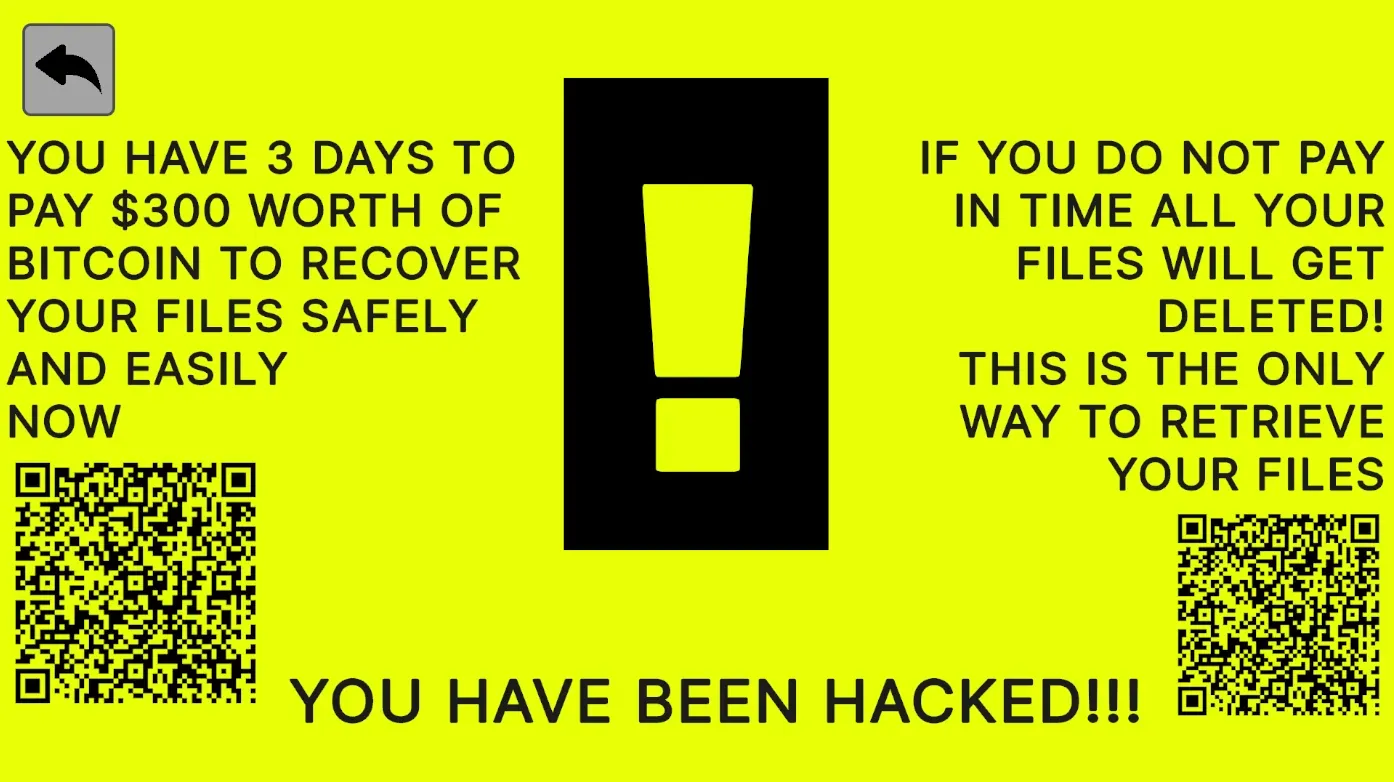
BlackLock Ransomware GroupRansom Screen Notice
"=== ATTENTION: ALL YOUR IMPORTANT FILES HAVE BEEN ENCRYPTED ===
All your corporate databases, documents, customer PII, and backups are locked with military-grade encryption algorithms.
To restore your systems:
- Download the Tor Browser from https://www.torproject.org
- Open our private portal: http://blacklock5x9...onion
- Enter your Unique Client ID: 894F-29BC-EE01
PRICE: 4.5 BTC (Bitcoin). You have 72 hours before the decryption key is permanently deleted and all private files are released on the public darknet."
Defense Checklist
Ransomware Resilience Rules
- Maintain Immutable, Offline Backups (3-2-1-1-0 Rule): Ensure at least one full backup is physically disconnected (air-gapped) or stored in an immutable, write-once-read-many (WORM) cloud repository.
- Never enable macros or execute unexpected script attachments: Office documents asking you to "Enable Content" or "Enable Editing" to view content are almost always weaponized droppers.
- Enforce the Principle of Least Privilege: Standard employee accounts must not have local administrative rights on their machines.
- Isolate and patch remote access interfaces: Never expose Remote Desktop Protocol (RDP) directly to the open internet; mandate VPN with strict multi-factor authentication.
- Deploy Endpoint Detection & Response (EDR): Modern behavioral EDR tools can detect mass file modification and isolate the infected host automatically.
Immediate Incident Containment
Ransomware Detected? Take Instant Containment Actions
- Disconnect immediately from physical networks: Unplug ethernet cables and turn off Wi-Fi and Bluetooth on all affected devices immediately. DO NOT turn off the power (RAM holds crucial decryption keys and malware artifacts).
- Do not pay the ransom: Cybersecurity authorities and law enforcement strongly advise against paying ransoms. Payment fuels criminal syndicates, does not guarantee data recovery, and marks your company as an easy repeat target.
- Isolate network segments and storage arrays: Take offline network-attached storage and shared drives to stop encryption traversal.
- Contact certified forensic responders & law enforcement: Engage certified incident response teams to secure forensic evidence and guide secure recovery from immutable backups.
Resources & References
- CISA #StopRansomware – Official U.S. government guidance, threat alerts, and ransomware playbooks.
- Komerční banka – Škodlivý software a ochrana dat – Banking client advisory on malware infections and prevention.
- NÚKIB – Reakce na ransomware incidenty – National Cyber and Information Security Agency ransomware defense guide.
- MITRE ATT&CK – Technique T1486: Data Encrypted for Impact – Tactical breakdown of ransomware encryption behaviors.